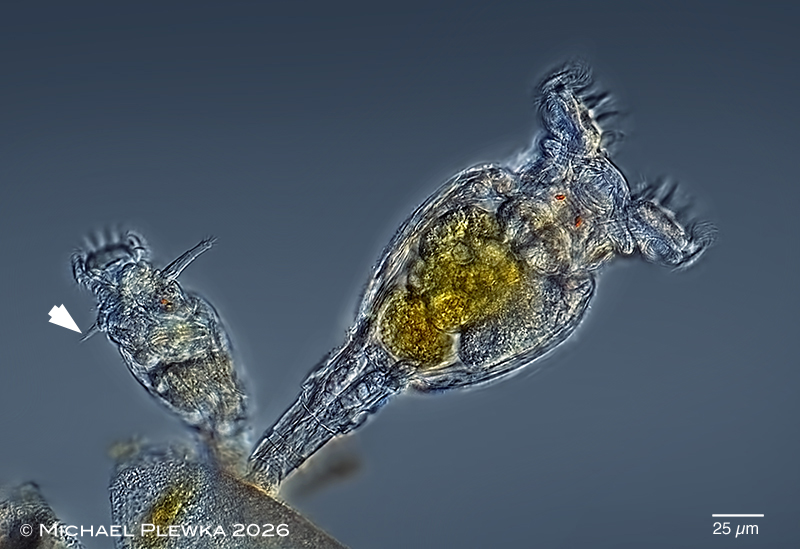
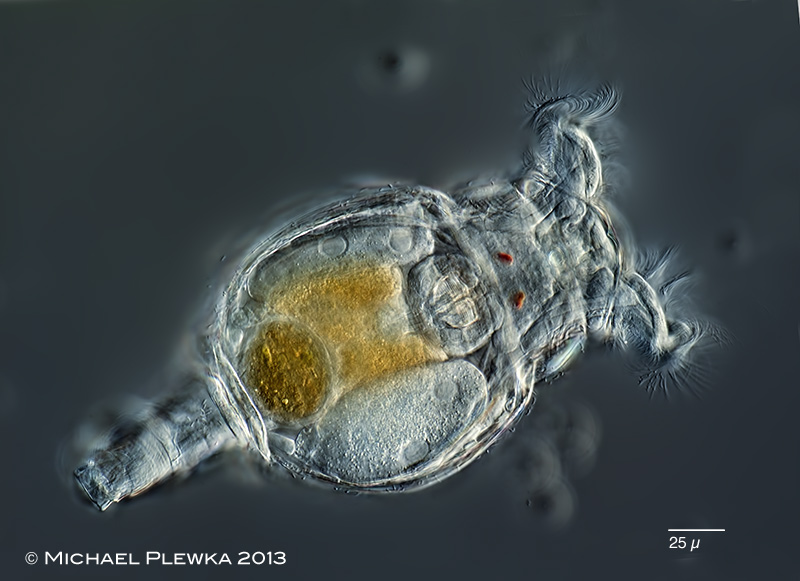
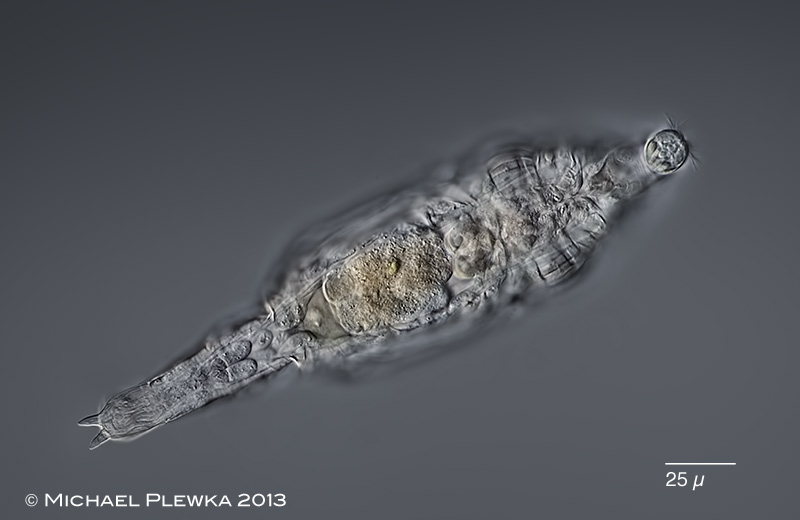
| Philodina megalotrocha, swimming specimen, dorsoventral view. A species with a characteristic barrel-shaped trunk that is distinct from the cylinder-shaped foot. Sulcus is very wide (sulcus width ≥ width of trochal disc). The orange eyespots are clearly visible (2). |
| |
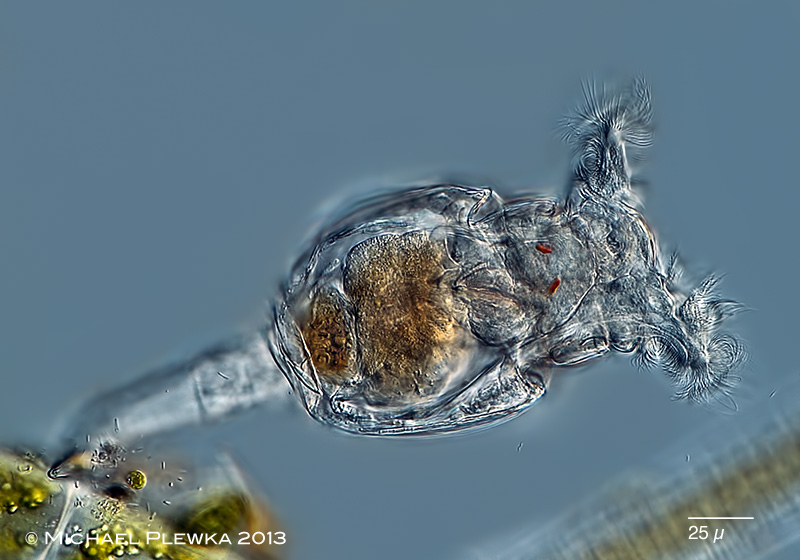 |
| Philodina megalotrocha, whirling, another specimen from the same location as above, while attached to filamentuous algae. The rotifer uses the corona also for swimming. (2). |
| |
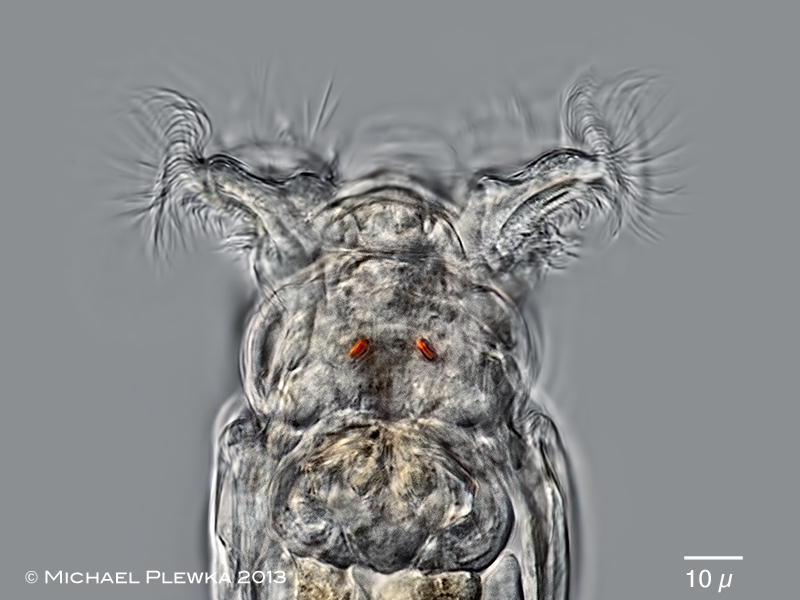 |
| Philodina megalotrocha, head while whirling, dorsoventral view; focus plane on the upper lip and the red eyespots. (2) |
| |
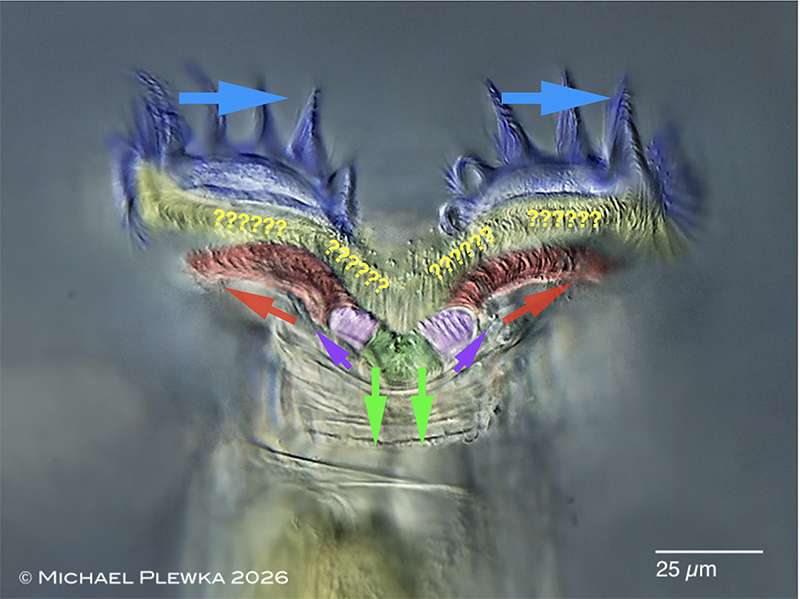 |
| Philodina megalotrocha, head while whirling, ventral view; ciliary arrays with different function/ metachronal movement are in different artificial colors. Blue: trochal cilia; yellow: cilia of circumapical band; red: cilia of cingulum; violet: buccal field A; green: buccal field B. The arrows mark the direction of the metachronal waves of these arrays. The cilia of the circumapical band are very short, so that metachronal waves cannot be unambiguously recognised, probably there is symplectic metachrony. |
| |
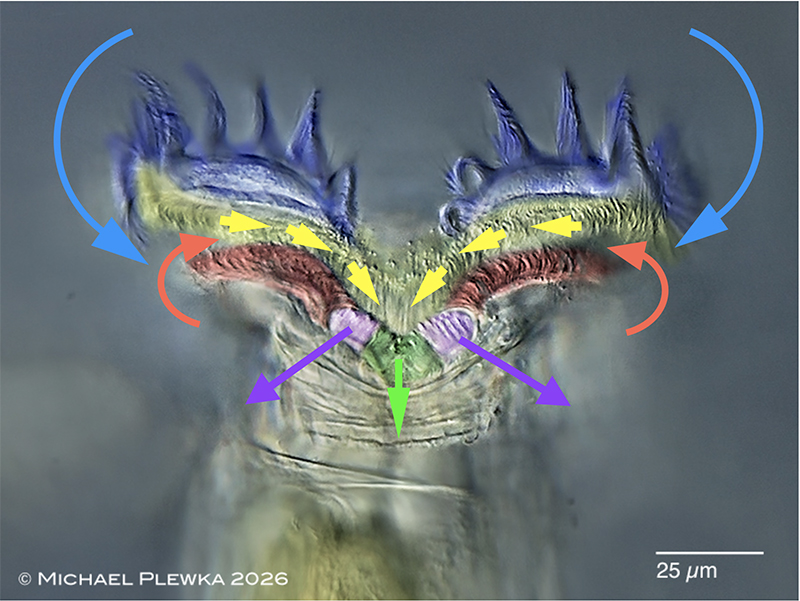 |
| Philodina megalotrocha, same photo as above; also ciliary arrays with same artificial colors as in the above image. The arrows mark the direction of water/ particle flow generated by the effective stroke of the cilia in the corresponding area. Particles are driven by the backwardly directed effective stroke of the long trochal cilia (blue). The effective stroke of shorter cilia of the cingulum (red) directs most of the particles into the groove of the circumapical band (yellow), the cilia of which drive the particles to the central area of the buccal field. Some particles are then driven to the mouth / mastax by the cilia of the green area. The other particles are sorted out via the effectice stroke of the cilia of the violet arrays. |
| |
 |
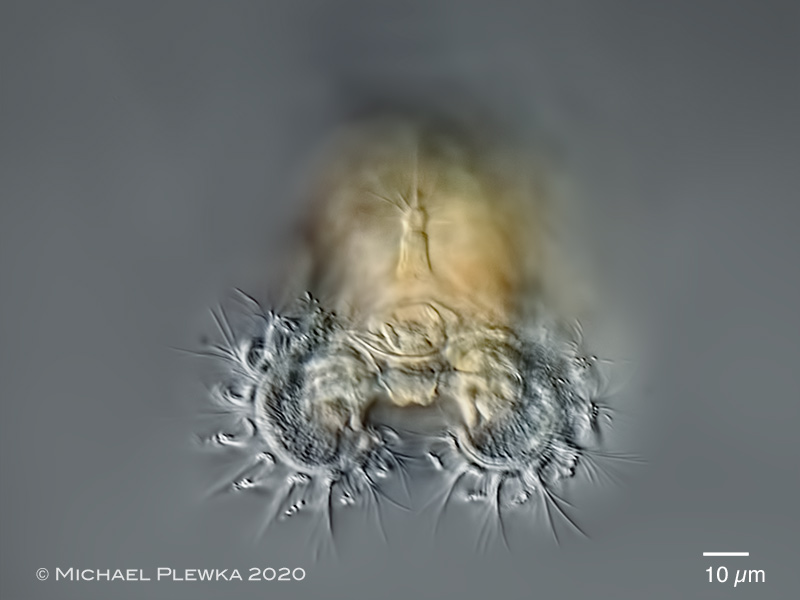
| Philodina megalotrocha, creeping, ventral view showing the rostrum (2). |
| |
 |
| Philodina megalotrocha, frontal view of specimen from (4), showing the upper lip |
| |
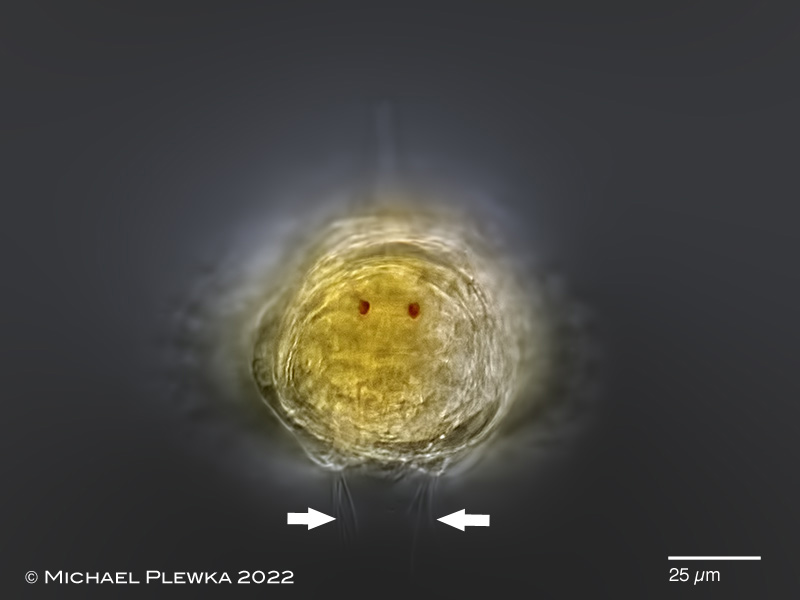 |
| Philodina megalotrocha, optical transect; in this frontal view the eyespots appear (nearly) circular. The arrows point to some long bristles at the end of the cingulum which are also visble in the next image (arrow)(5) |
| |
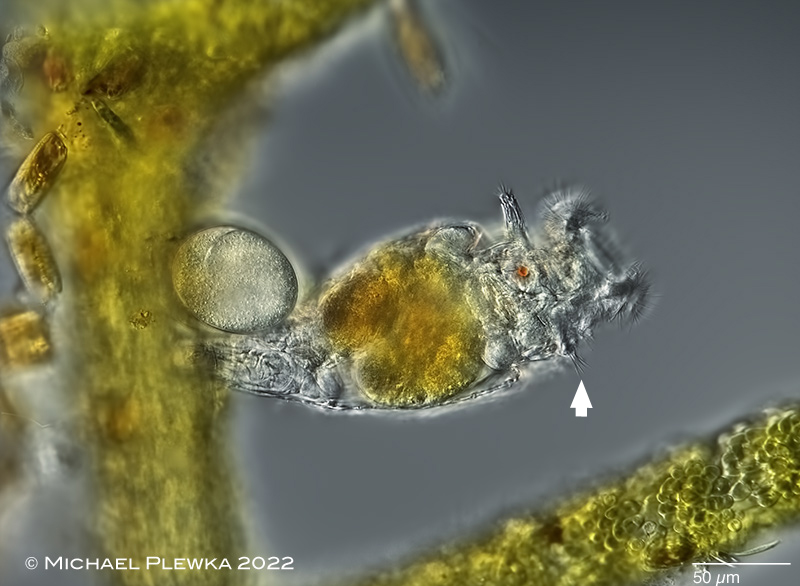 |
| Philodina megalotrocha, specimen with egg on the rhodophyte Torularia atra, whirling, lateral view. The arrow points to some long bristles at the end of the cingulum which are also visble in the previous image (arrows) (6) |
| |
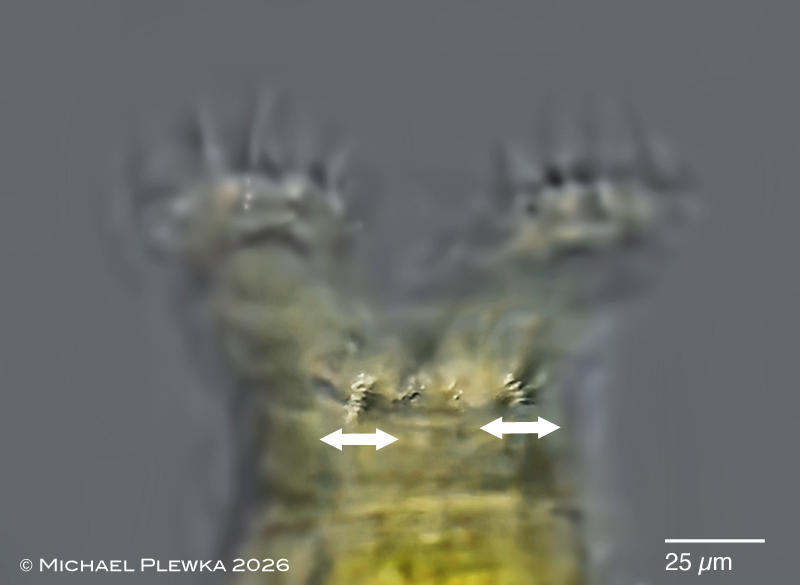 |
| Philodina megalotrocha, head; ventral view; focal plane on the ventral lobes with cilia which are in permanent oscillating movement (double arrows) orthogonal to the longitudinal axis. The frequency of the beating of these mebranelles is about 120 Hz. This is the only bdelloid rotifer species where I observed such bristles; also the function of these bristles is unclear. May be these cila arrays are homologous to the lateral / ventral antennae of the monogononts This is a still image of a YT-video that also shows the movement of the cilia of the corona.(8) |
| |
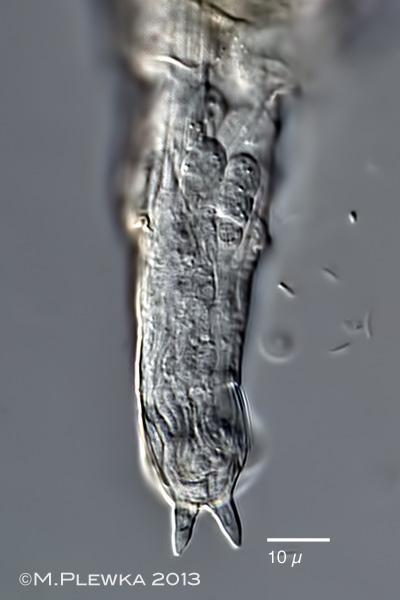 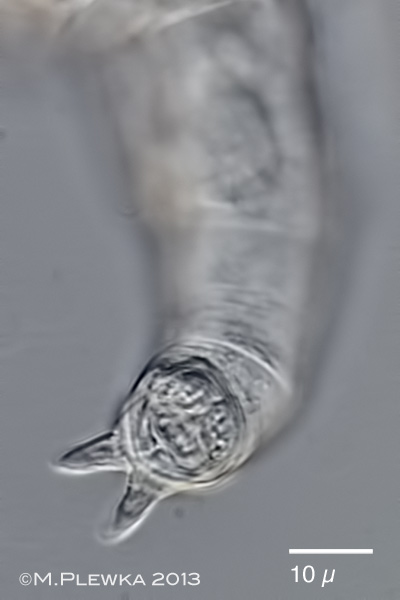 |
| Philodina megalotrocha, two aspects of the foot of creeping specimen. Left: foot with spurs, dorsal view Right: ventral view; focal plane on the 4 toes (spurs are also visible) .(3) |
| |
| |
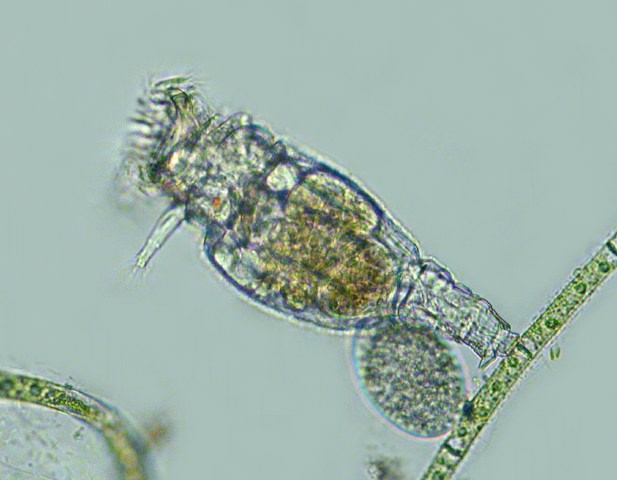 |
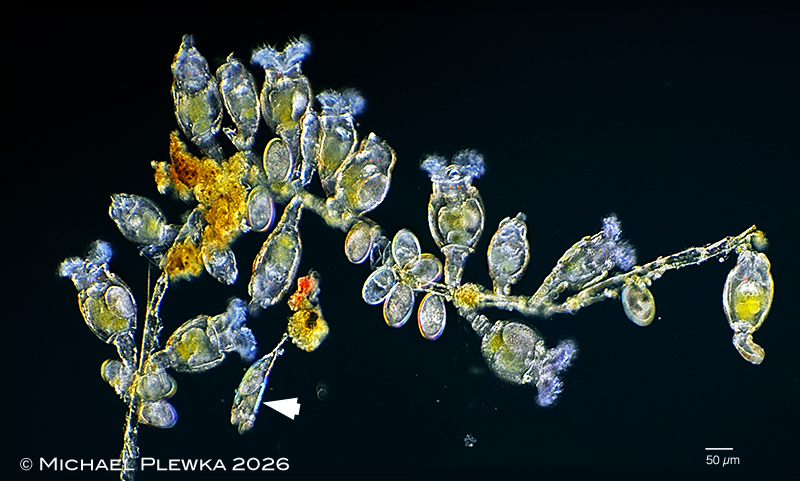
| Philodina megalotrocha, lateral view of a specimen with an egg. Like most Philodina-species also P. megalotrocha is oviparous. A characteristic behavior of P. megalotrocha is that the eggs are attached to filamentous alge like the Mougeotia sp. here. The current created by the cilia of the trochal discs brings fresh water to the egg; so this is some sort of parental care (1). |
| |
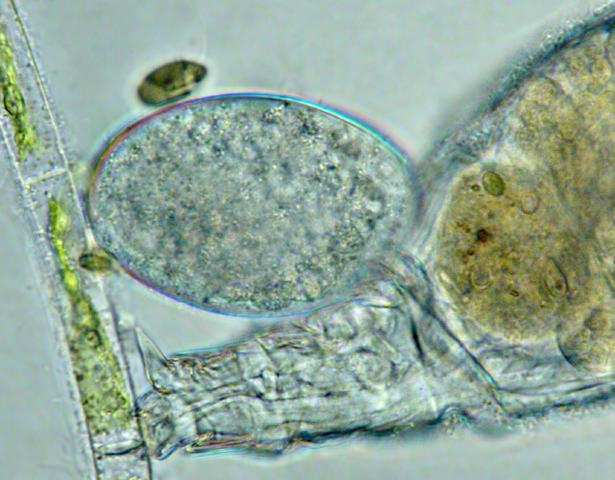 |
| Philodina megalotrocha, foot with toes and egg (1). |
| |
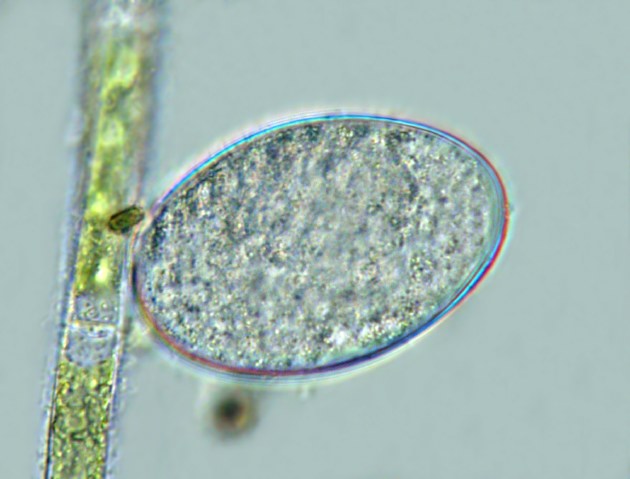 |
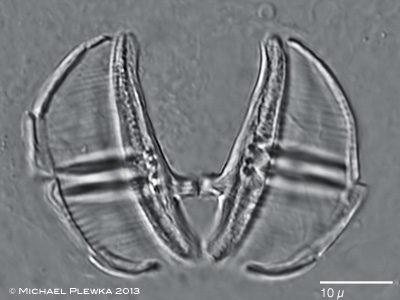
| Philodina megalotrocha, egg (1) . |
| |
  |
| Philodina megalotrocha, ramate trophi. Left: cephalic view; with dental formula (DF):2/2. Right: caudal view; ramus length (RaL): 32µm. Images not to scale. (3) |
| |
| |
| |
| |
|
|
| |
| |
| |
| Location: Passo di Lavazè (1800m), Trentino, Italia, lake (2), Anhausen, Bavaria, fishponds (3); Gwell Kaer, Brittany, France; creek (4) |
| Habitat: Periphyton with Fragilaria sp., Spirogyra sp., Desmidium swartzii, Diatoms, together with Otostephanos donneri and Cephalodella paxi (2); Periphyton (3); (4) |
| Date: coll.: 28.09.2013; img.: 30.09..2013) (2); coll.: 29.9.2013, img 3.10.2013 (3); 22.08.2020 (4) |
| |
| |
|
Location (5); (6): Wupper near Müngstener Brücke; |
 |
| |
| Habitat (5); (6): epibiontic on the red alga Torularia atra in lotic water |
| |
| Date : 18.07.2022 (5); 03.08.2022 (6) |
| |
|
|
|
|
|
| |
| |
|
|
| |
| |
| Location: Passo di Lavazè (1800m), Trentino, Italia, lake (2), Anhausen, Bavaria, fishponds (3); Gwell Kaer, Brittany, France; creek (4) |
| Habitat: Periphyton with Fragilaria sp., Spirogyra sp., Desmidium swartzii, Diatoms, together with Otostephanos donneri and Cephalodella paxi (2); Periphyton (3); (4) |
| Date: coll.: 28.09.2013; img.: 30.09..2013) (2); coll.: 29.9.2013, img 3.10.2013 (3); 22.08.2020 (4) |
| |
| |
|
|
|
|